Inspiration Gallery
Blog
Tile Calculator
08065423741



.svg)


How to Read Tile Specifications Before Buying
ByNandana Priya

Sun , Jul 05 , 2026

Read Time: 5 Min


 Copied!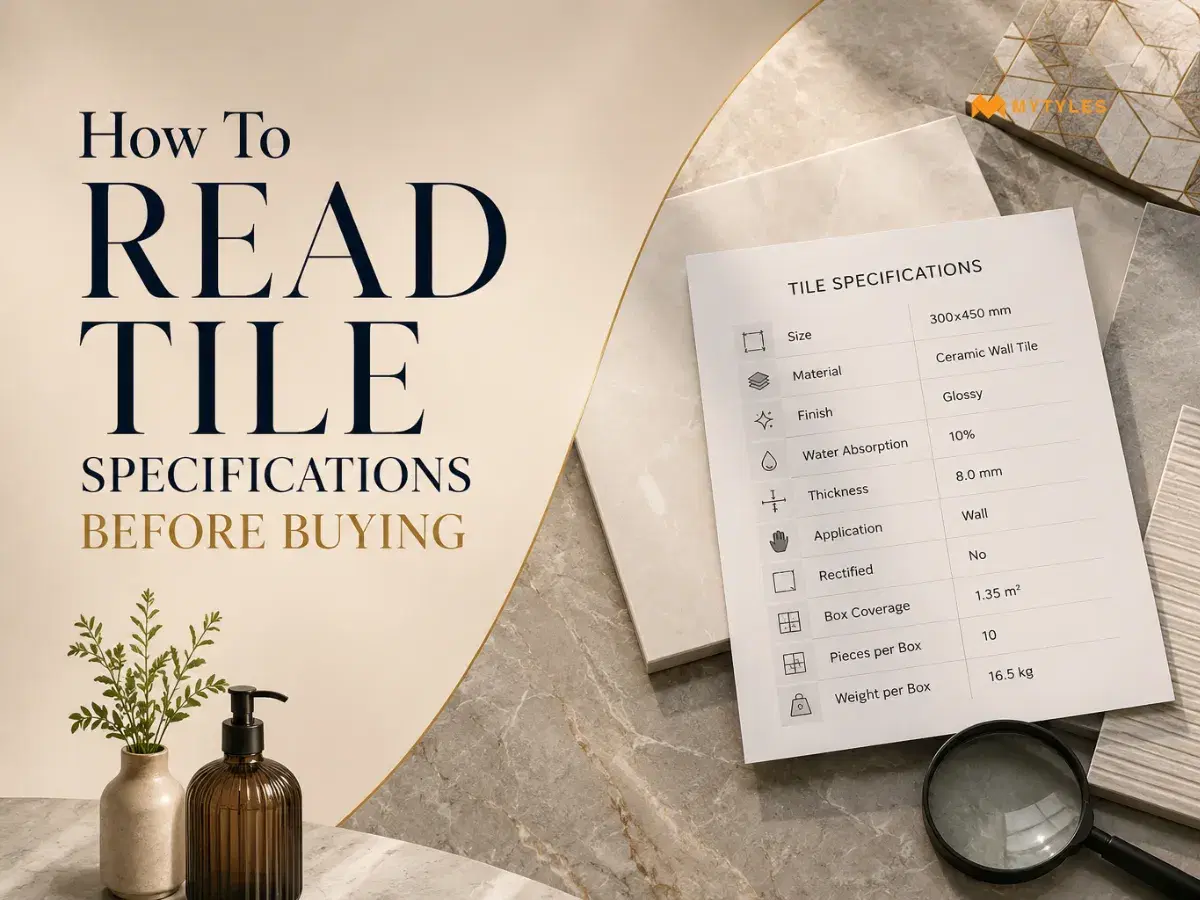
Tiles are a long-term investment. We see tiles almost everywhere in homes, shopping malls, offices, and parking lots; they are on the floors we walk on and the walls we touch. However, nobody would want their tiles to fade and chip as time passes. Replacing them again within a short period involves more money and time. Such problems can be prevented by using the tile specifications that are just right for your space.
To be a smart tile buyer, knowing tile specifications is crucial. A basic knowledge of the materials, finishes, colors, size, thickness, slip resistance, water absorption, and suitability of the tiles for a particular space is all you need. This tile specification guide is about the important things to consider before buying tiles.
Tile Size: Getting The Basics Right
When it comes to tile specification, size becomes a major factor. Size influences what material works for that space, what finish holds up, how thick the tile needs to be, how much water it can handle, and whether the tile is suitable for the space. You can now find tile-size specifications from small mosaic pieces to large-format slabs of 1200x2400 mm. This larger choice of tile sizes offers you the flexibility to add tiles to different layouts and to serve different purposes.
Size | Format | Common Use | Why It Works |
|---|---|---|---|
| 100x100 mm / 150x150 mm | Small | Kitchen walls, cafes, bathrooms | Gives a retro or handmade feel. Works well as an accent or feature wall. |
| 300x300 mm / 300x600 mm | Medium | Bathrooms, utility areas, and kitchen walls | Easy to lay around fixtures and fittings. Good for spaces with lots of cuts. |
| 600x600 mm | Standard | Living rooms, bedrooms, and general flooring | A simple, practical choice that suits most residential floors without much fuss. |
| 800x800 mm | Large | Large living areas, commercial spaces | Makes a room feel more open. Fewer joints mean a cleaner finish. |
| 1200x600 mm and above | Slab | Open-plan floors, feature walls | Minimal joint lines give a seamless, premium look but need a very flat base and skilled installation. |
Materials: Ceramic, Vitrified, Or Porcelain
The material of a tile defines how durable, water-absorbent, maintenance-friendly, and expensive the tile is. The types of tile materials show how durable, safe, and appropriate the tile is for the space. Let us discuss some of the common ones.
Ceramic Tile Specifications
- Ceramic tiles are made from clay and fired at lower temperatures.
- Lighter, easier to cut, and more affordable, but they absorb more water, so they work best on indoor walls and low-traffic floors.
Vitrified Tile Specifications
- Most of the floor tiles you see in Indian homes are vitrified tiles.
- Fired at a high temperature, they’re dense, and water hardly gets in, with absorption below 0.5%.
- Tough, easy to clean, and holds up well in spaces that get a lot of daily use.
Porcelain Tile Specifications
- Porcelain tile uses a finer clay mix, so water absorption goes even lower.
- Harder and longer-lasting, making it a practical choice for busy floors, wet areas, and outdoor spaces
Matt, Glossy, Sugar: What Each Finish Actually Means
The tile finish type is not just about looks. It changes how the tile feels underfoot, how often you need to clean it, and whether it actually suits the space you are tiling.
Glossy Tiles
- Shiny surfaces that bounce light tend to make rooms feel a bit bigger and brighter with these tiles.
- Great on walls, but on the floor, marks and scratches show up fast and might be slippery when wet.
- Glossy tiles work well in dry, low-traffic areas like bedroom walls or living room feature walls. Here, the reflective surface does its best without the wear showing up quickly.
Matt Tiles
- Matt tiles have a non-shiny surface. They absorb light rather than reflecting it, which gives a space a calmer, more grounded feel.
- The slightly structured surface is what gives matt tiles their grip. They are reliable on floors that see water regularly.
- They hide marks better, and they give more grip underfoot. This is the safer option for floors, especially in wet areas, like the bathroom, kitchen, and balcony.
Sugar Tiles
- The surface has a fine, granular texture that looks and feels similar to raw sugar crystals.
- The finish catches light in a very subtle way.
- Practical choice for floors and works well in living rooms, bedrooms, and feature walls.
PEI Rating: The Number That Tells You Where A Tile Can Go
PEI stands for Porcelain Enamel Institute, an industry body that developed the standard test for tile surface wear. The rating tells you how much foot traffic a tile's surface can handle before showing wear. It ranges from 0 to 5. The tile PEI rating tells us how suitable it is to use in a particular room.
PEI 0 — Wall use only.
PEI 1 — Very light use, like a bathroom with bare feet only.
PEI 2 — Light residential. Bedrooms and bathrooms with soft footwear.
PEI 3 — Most residential floors. Living rooms, kitchens, hallways.
PEI 4 — Heavy residential and light commercial. Offices, retail.
PEI 5 — High-traffic commercial. Malls, airports, hospitals.
Quick Tip: For most homes, PEI 3 is good to go. Entrances and home offices with heavy use are worth upgrading to PEI 4.
R Rating: Do Not Skip This If Your Tile Goes Near Water
The R rating measures the tile slip resistance. This shows how much grip the tile can provide, especially in spaces exposed to water such as bathrooms, terraces, and parking areas. It ranges from R9 to R13. The R rating and finish work together. A matt anti-skid tile will generally score higher than a glossy tile when it comes to slip resistance.
R9 — Dry indoor areas. Entrance halls, living rooms.
R10 — Light wet areas. Domestic bathrooms, kitchens.
R11 — Moderate wet or outdoor use. Balconies, commercial kitchens.
R12 — Heavy wet exposure. Pool surrounds and industrial kitchens.
R13 — Extreme conditions. Heavily wet industrial floors.
Mohs Hardness: How Scratch-Resistant Is Your Tile?
As we have discussed wear resistance and grip in the above section, let us know more about scratch resistance. The Mohs scale measures how resistant a tile's surface is to scratching. This ranges from 1 (very soft) to 10 (high scratch resistance). For floor tiles, anything above 5 is generally good.
A low tile Mohs rating does not mean the tile is bad. It means you need to be more careful about grit, furniture, and daily wear on that surface.
Rectified vs Non-Rectified Tiles: What Is The Difference?
When tiles come out of the kiln, the firing process can cause very slight changes in size and shape. Not every tile comes out exactly the same, and that is the reason rectified and non-rectified tiles exist as two separate categories. The difference between the two is not just about appearance. It decides how the tiles are installed, how wide the grout joints need to be, and how the finished surface looks across a large area.
Non-rectified tiles are left as they come out of the kiln, with natural edges and slight size variation between pieces. Rectified tiles go through an extra cutting process after firing, so every tile comes out to exact dimensions with clean, precise edges. The type you choose determines how thin or wide the grout joints will be and how seamless the finish looks.
Specification Point | Rectified Tiles | Non-Rectified Tiles |
|---|---|---|
Edge finish | Edges are mechanically cut after firing for a sharper and more uniform size. | Edges are natural after firing, so slight size variation can be present. |
Joint width | It can be installed with very narrow grout joints. | Needs wider grout joints to manage small size differences. |
Installation | Needs skilled installation because narrow joints leave less room for adjustment. | Easier to install because wider joints allow more flexibility. |
Best use | Living rooms, bedrooms, premium floors, large-format tiles, and modern interiors. | Walls, regular floors, budget-friendly projects, and spaces where visible grout lines are acceptable. |
Why The Details On A Tile Box Matter More Than You Think
Every tile box detail carries a shade code, product name, size, batch number, finish, and box coverage. Easy to overlook, but ignoring it is one of the most common reasons installations end up looking patchy.
Tiles are made in batches. The same design from the same brand can look slightly different across two production runs. The shade code tells you which batch a box belongs to, and tiles from different codes may not match. Check that every box in your order has no tile shade variation before work starts. Verify that the product name, size, batch number, lot number, shade code, finish, and box coverage all match.
Before You Open The First Box, Check For:
- Product name and tile size
- Batch number and lot number
- Shade code
- Finish type
- Any visible damage to the box or tiles inside
Floor, Wall, Outdoor, Wet Areas: Which Tile Works Where?
Not every tile works in every space. A tile that looks great on a wall may crack under foot traffic. One that works perfectly outdoors may be too rough for a bedroom floor. Knowing where each tile specification belongs saves you from costly mistakes after installation.
Area | Tile Specifications |
|---|---|
| Walls | Lighter and thinner tiles work best here. Ceramic and porcelain are common choices. Glossy finishes are fine on walls since there is no slip risk or heavy wear to worry about. |
| Floors | Floor tiles need adequate thickness, a tile PEI rating of at least 3, and a finish that handles foot traffic. |
| Outdoor Areas | The best choice is porcelain with a low water absorption and an anti-skid finish. The tile should be able to withstand rain, heat, and temperature changes without cracking. |
| Wet Areas | Water-resistant tiles and slip resistance are non-negotiable when it comes to areas that face water every day. For bathroom tile specifications, R-10 is the minimum. Balconies and pool surrounds need R11 or above. |
Final Checklist Before You Buy
- Go for the right size, material and finish so that the tile sits just right in your space.
- Confirm the tile PEI rating matches the traffic level of your space.
- Check the R rating for any wet or outdoor area.
- Check the tile's Mohs rating if the area sees heavy use or furniture movement.
- Check the shade code on every box before work starts.
- Order at least 5–10% extra from the same batch for cuts and future repairs.
Know What You Are Buying Before It Goes Down
Tile specifications are not there to confuse you. They help you pick the right tile for the right space. A tile that looks perfect in the showroom but carries the wrong PEI rating or no slip resistance will let you down fast in real conditions.
Check the shade code, the rating, the finish, and the suitability before you buy. It is far easier to swap a tile before purchase than to relay an entire floor after installation. Browse our full tile range, where every product lists its specifications clearly, so you can compare, confirm, and buy with confidence.
Expert Reviewed by Biren Agrawalla
Biren Agrawalla, the Founder of MyTyles with over 10 years of experience across tile, retail, and home decor. Driven by a passion for tiles and a deep understanding of customer behaviour, he has spent his career transforming how people discover and buy tiles online. Biren combines practical retail insight with modern digital solutions to make tile shopping smarter, more intuitive, and design focused. At MyTyles, he champions a customer first approach, ensuring every experience from browsing to buying is reliable, seamless, and inspiring.

What Are Tile Specifications?

Tile specifications are technical details that describe a tile’s performance, dimensions, and suitability for different applications. These specifications may include size, thickness, water absorption, slip resistance, PEI rating, MOH hardness rating, finish, and material type. Understanding these details helps buyers compare products accurately and choose tiles that meet both design and functional requirements.
How Do You Read Tile Specifications Before Buying?
Reading tile specifications involves checking important details such as tile size, thickness, material, finish, water absorption rate, slip resistance, and durability ratings. These values help determine whether a tile is suitable for floors, walls, wet areas, or commercial spaces. Reviewing specifications before purchase reduces the chances of selecting tiles that may not perform well in the intended environment.
What Should You Check Before Buying Tiles?
Before buying tiles, it is important to review the material type, tile size, finish, slip resistance, water absorption, durability ratings, and shade variation. You should also consider where the tiles will be installed and how much foot traffic the area receives. Evaluating these factors helps ensure the selected tiles meet both practical and aesthetic requirements.
How Can You Check Tile Quality Before Purchase?
Tile quality can be assessed by checking the surface finish, edge consistency, dimensions, durability ratings, and overall manufacturing quality. Check that the product name, batch number, lot number, shade code, and finish match across every box in your order. Inspecting multiple tiles for visible defects, chips, or excessive variation is also useful. Reviewing technical specifications and purchasing from reliable suppliers helps ensure the tiles deliver consistent performance and long-term durability after installation.
What Does Tile Water Absorption Mean?
Water absorption refers to the amount of moisture a tile can absorb through its body. Tiles with lower water absorption are generally more resistant to stains, moisture damage, and weather exposure. This characteristic is particularly important for bathrooms, kitchens, balconies, and outdoor areas where water exposure is frequent and long-term durability is required.
What Is A PEI Rating In Tiles?
PEI rating measures a tile’s resistance to surface wear caused by foot traffic and abrasion. The scale typically ranges from PEI 1 to PEI 5. Lower ratings are suitable for walls and light-use areas, while higher ratings are designed for residential floors, commercial spaces, and high-traffic environments that require stronger long-term durability.

ABOUT THE AUTHOR
Nandana Priya
With a strong interest in design, creativity, and emerging tile trends, I enjoy turning ideas from the world of tiles and interiors into engaging, meaningful reads. My writing focuses on creating well-researched content that helps readers understand design choices with more clarity and confidence. I bring together research, design awareness, and digital marketing insights to craft content that is relevant, easy to follow, and thoughtfully written for todays homeowners and design-conscious readers.
Latest Blogs By MyTyles