Inspiration Gallery
Blog
Tile Calculator
08065423741



.svg)


Tile Flatness Test: Why Some Tiles Create Uneven Flooring
ByNandana Priya

Sun , Jun 07 , 2026

Read Time: 5 Min


 Copied!
A tile might seem fine at first. However, even a small bend, curve, or lifted corner can create problems after installation. At times, while walking, you may notice one tile edge sitting higher than the next, grout lines looking uneven, or a corner that lifts just enough to become a tripping spot. This becomes even more noticeable with rectified and large-format tile installations, where small unevenness in the tile or base surface can show up clearly after installation.
That is why the tile flatness test should not be neglected. It is a tile quality test that assesses how much a tile deviates from a perfectly flat surface. Understanding this even at a basic level will be helpful in the tile-buying journey. This blog simplifies what tile flatness really is, how it’s tested, and ways to prevent irregular tile flooring.
The Basics Of Tile Flatness
Tiles may look flat, but it would be impossible for every tile to be entirely even. This is because of the firing and cooling process. The tiles are exposed to high heat, and even a small difference can create a slight curve, bend, or lifted corner.
When such a tile is installed without proper surface preparation or alignment, these small variations can show up as uneven edges on the floor. This visible height difference between two neighbouring tiles is called tile lippage.
Tile flatness, substrate flatness, and floor levelness are all related, but they are not the same. The table below shows the difference in a simple way.
Term | Meaning | Why It Matters |
|---|---|---|
| Tile Flatness | How flat the tile itself is. | A curved or uneven tile can cause raised edges or uneven grout lines. |
| Substrate Flatness | How flat the floor or wall surface is before fixing tiles. | Uneven bases can lead to lippage, hollow sounds, and poor bonding. |
| Floor Levelness | Whether the floor is horizontally even or slightly sloped. | Important for drainage, furniture placement, and overall comfort. |
Understanding The Tile Flatness Test
The tile flatness test tells you whether a tile falls within the accepted range of flatness or whether it has enough of a curve or warp to cause problems during installation. The test is usually done in two phases.
Factory
At the factory, flatness is checked in two ways through sample testing and quality control processes. In sample testing, selected tiles are taken from a batch and checked for surface flatness, dimensional accuracy, variation in thickness and visible faults before dispatch. This ensures the tiles meet the accepted tile surface flatness.
In the next method, at some factories, an automatic surface planarity machine is used. As tiles move through the final stages, the machine scans each surface and records any deviation from flat. If a tile is outside the accepted range, it is flagged and removed from the batch.
On-site
The wall or floor surface is checked before starting the installation. Even the tile with suitable flatness can be uneven if the surface has dips or high spots. Floor levelling before tiling is usually done with a 2-metre straightedge, which is placed across the surface in different directions.
The base surface must be well prepared to prevent lippage of the tiles and uneven flooring. The installer should first correct the uneven floor base or wall surface by filling low spots, grinding high spots, or levelling the surface before laying the tiles. Make sure the adhesive bed thickness is right and covers the back of the tile fully. If there are gaps underneath, the tile loses support. Skipping this step causes problems even with a good-quality tile.
The Real Reasons Tiles Warp During Manufacturing
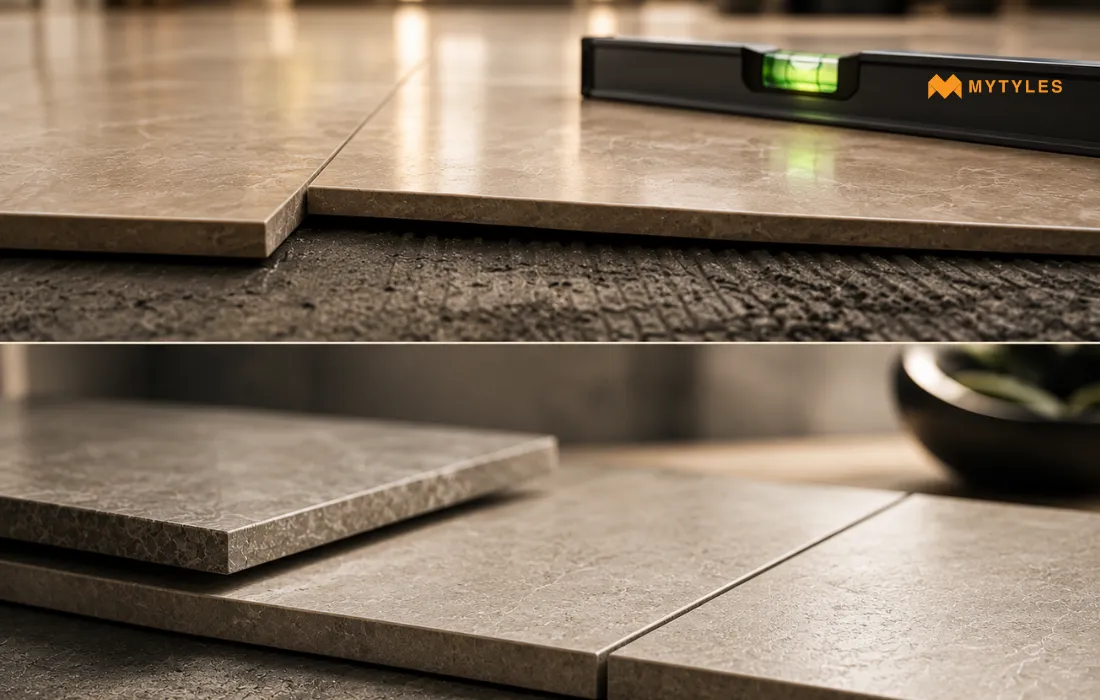
A warped tile is one that has a slight bend or curve to it. This can happen during manufacturing as the tiles are put through some pretty intense processes like shaping, pressing, and then firing inside kilns at extremely high temperatures.
Not all parts of the tile cool at the same rate as tiles leave the kiln. These small, uneven cooling differences are what become tile warpage. Tile dimensional accuracy is affected by variation in tile thickness, material density and position in the kiln. There are three types of warpage:
- Edge Warpage: Edge warpage is when the long sides of a tile curve either upward or downward. When this tile goes on the floor, the centre sits flat, but the tile edges are not level; they either lift above or sink below the neighbouring tiles.
- Diagonal Warpage: Diagonal warpage runs from one corner of the tile to the opposite end. It is like a gentle twist across the full surface. This usually becomes visible when light hits the floor at a low angle.
- Corner Warpage: One or more corners of the tile lift slightly away from the flat plane, while the rest of the tile sits fine. For this tile warpage test, it is detected by placing the tile on a hard surface and pressing each corner. The tiles with corners raised will have a slight up-and-down movement.
How to Prevent Tile Lippage Before It Becomes a Problem
.webp)
Tile lippage does not happen by accident. The height difference between neighbouring tiles can also be the result of poor installation.
- The surface has to be flat before anything goes down. Any high or low spots in the base will show through once the tiles are fixed. Use a straightedge to check the surface level.
- Adhesive coverage matters too. Thin or patchy adhesive leaves hollow spots under the tile, which causes edges to sit higher than they should. Applying adhesive to the back of the tile as well as the floor is called 'back buttering', and this is especially helpful with larger format tiles.
- Keep grout joints consistent. Uneven joints make tile lippage worse visually, even when the tiles themselves are flat.
- For large-format tiles, the tile levelling clips and wedge system make the process simple and effective. The clip sits under the edge of two adjacent tiles, and a wedge is pushed through to pull both tiles to the same height.
Tile Flatness Standards
Not every tile that looks slightly uneven is a defect. There are accepted limits for how much variation is allowed, and these differ based on tile type, size, and where it is being used.
There are three separate checks. ISO 10545-2 and ASTM C485 check the tile surface before installation. ANSI A108.02 is about the flatness level of the base where the tile is installed. The acceptable limits vary depending on tile type and size.
Standard | Stage | What It Covers |
|---|---|---|
| ISO 10545-2 | Tile manufacturing | Checks surface flatness, edge straightness, and whether tile dimensions are within acceptable range |
| ASTM C485 | Tile manufacturing | Looks at warpage, how much a tile has bent or twisted during the firing process |
| ANSI A108.02 | Installation | How flat the base surface needs to be before tiling begins, and acceptable lippage limits in the finished floor |
A Simple Flatness Check
A tile inspection before installation can save money and effort. These checks take less than a minute, and you do not need any special equipment for this.
- Stack Test: Pick two tiles from the same batch and place them face-to-face. Run your fingers around the edges; any gap between the two faces is a sign of warpage.
- Rock Test: Set one tile flat on a hard surface and press each corner. If it rocks, that is a corner warpage.
- Straightedge Test: Hold a ruler across the tile face, first side to side, then corner to corner. A gap in the middle means the edges are curving upward and a space at the edges means the centre is lower.
A Better Finish Starts With The Right Tile Check
Tile flatness is one of those details that most buyers never think about until there is a problem. By that point, the tiles are down, and the grout is in. Fixing this means starting over. The tile flatness test exists to find these problems before they reach the surface. While choosing tiles for your home or any project, take time to check the tile surface flatness, quality, and installation needs. This will save you time and money. Browse the MyTyles collection on the website or visit our experience centre and let our tile experts help you choose tiles that suit your space, layout, and installation needs.
Expert Reviewed by Biren Agrawalla
Biren Agrawalla, the Founder of MyTyles with over 10 years of experience across tile, retail, and home decor. Driven by a passion for tiles and a deep understanding of customer behaviour, he has spent his career transforming how people discover and buy tiles online. Biren combines practical retail insight with modern digital solutions to make tile shopping smarter, more intuitive, and design focused. At MyTyles, he champions a customer first approach, ensuring every experience from browsing to buying is reliable, seamless, and inspiring.

What Is A Tile Flatness Test?

A tile flatness test helps check whether a tile is even across its surface or has slight bends, curves, or raised edges. This matters because uneven tiles can create visible height differences after installation. The test is especially useful for large-format tiles, where small surface variations can affect alignment, grout spacing, and the final flooring finish.
Why Do Some Tiles Create Uneven Flooring?
Uneven flooring can happen due to tile warping, an unlevel subfloor, poor adhesive spreading, or incorrect installation techniques. Sometimes, even a good tile can look uneven if the base surface is not prepared properly. Checking flatness before installation helps reduce lippage, visible edges, and discomfort while walking on the finished floor.
How To Check Tile Flatness Before Installation?
Tile flatness can be checked by placing the tile on a completely level surface and observing whether all corners touch evenly. Another method is to place two tiles face-to-face and check for gaps between them. A straightedge or spirit level can also help identify bends, raised corners, or surface irregularities before installation starts.
What Are Tile Flatness Standards?
Tile flatness standards define the acceptable surface variation allowed in manufactured tiles. These limits may differ based on tile size, material, and production guidelines. Larger tiles usually require stricter flatness control because bends become more visible after installation. Reviewing product specifications before purchase helps ensure the tile is suitable for the intended flooring layout.
Can Large-Format Tiles Have More Lippage?
Large-format tiles can make lippage more visible because they cover a wider surface area. Even a small bend in the tile or unevenness in the floor base can show up at the edges after installation. Proper surface preparation, correct alignment, suitable grout spacing, and skilled installation are important for achieving a smoother finish with large-format floor tiles.
Why Is Tile Flatness Important For Large-Format Tiles?
Tile flatness is important for large-format tiles because bigger tiles cover more area and reveal unevenness more clearly. If the tile or subfloor is not flat, edges may sit higher and create lippage. Proper flatness checks help achieve smoother installation, straighter grout lines, better alignment, and a cleaner, premium-looking floor finish.
How Can You Avoid Uneven Tile Flooring?
Uneven tile flooring can be avoided by checking tile flatness, preparing the subfloor correctly, using the right adhesive, and following proper installation methods. Skilled installers also help maintain alignment and grout spacing. These steps reduce lippage, improve floor stability, and create a neat, comfortable, and long-lasting surface for everyday use.

ABOUT THE AUTHOR
Nandana Priya
I have a strong interest in design and creativity, and I enjoy translating the world of tiles and their trends into engaging reads. Focusing on creating well-researched content that feels meaningful to readers has always been my first priority. I bring a growing understanding of research, design, and digital marketing into my writing, with a focus on clarity, relevance, and thoughtful storytelling.
Latest Blogs By MyTyles