Inspiration Gallery
Blog
Tile Calculator
08065423741



.svg)


How PEI and R Ratings Help You Choose Better Tiles
ByNandana Priya

Thu , May 21 , 2026

Read Time: 5 Min


 Copied!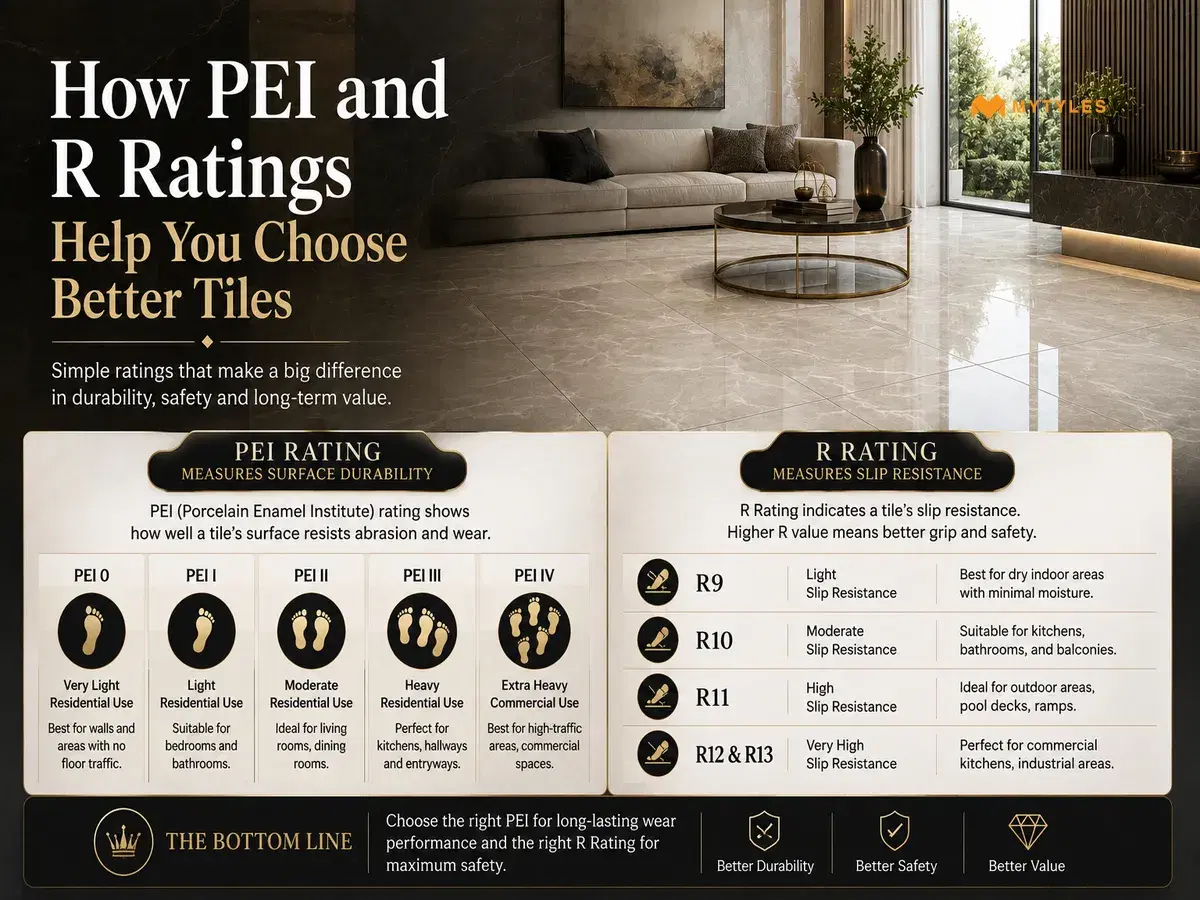
Buying tiles is more than just about looks. Most people walk into the showroom knowing exactly what color, pattern, and size they want. But the actual part that determines the tiles' performance is ignored by many. The two most important factors are grip and durability, which are determined by the PEI and R ratings for tiles. So what exactly are the tile 'R' rating and ‘PEI’ rating, and how much importance do they have? This blog breaks down what these ratings mean, how they work, and how they matter for each space.
What Are Tile Ratings?
Tiles can give your space the right look, but meeting the practical needs of the area depends on the performance of the tile as time passes by. This is where the tile quality ratings come into the spotlight. Not every tile is built the same way. Even with the same price range or finish category, the tile performs differently in a space.
PEI and R ratings for tiles come from standardised testing methods. This gives buyers, designers, and architects an honest picture of where a tile belongs, especially on floors, and where it will eventually fall short. They measure different things and need to be looked at before making the final decision.
What Is PEI Rating In Tiles
Developed by the Porcelain Enamel Institute, the PEI is a wear-resistance system that tells you how much movement a ceramic and porcelain tile can handle. This is limited to the glazed surface of the tile. The rating shows a simple way to find out if a tile is suitable for use in a particular room.
The PEI rating in tiles is tested by a machine that has abrasive materials and is pressed down over the glazed surface. The tile is exposed to this cycle repeatedly. Experts inspect when visible scratches or dullness begin to appear, and based on the total number of cycles, it is given a PEI rating.
The PEI rating for tiles is classified into five levels based on abrasion resistance. As the class moves from 0 to 5, the durability and resistance to wear also go up.
PEI rating | Wear level | Best used for |
|---|---|---|
| PEI 1 Class | Very light use | Bathroom walls, decorative wall areas, and TV unit walls |
| PEI 2 Class | Light use | Bedrooms, low-traffic bathrooms |
| PEI 3 Class | Moderate use | Living rooms, bedrooms, halls, foyers and regular home floors |
| PEI 4 Class | Heavy use | Kitchens, hallways, balconies, busy passages and high-use home areas |
| PEI 5 Class | Very heavy use | Commercial areas, shops, offices, parking areas |
What Is R-Rating In Tiles
'R rating' on tiles stands for the Ramp test. It is the European standard for determining how much grip or slip resistance a tile surface has. In simple words, this rating helps in finding out whether the tile is safe to walk on, especially in wet areas like bathrooms, terraces, and parking lots. This rating is used, more importantly, on floors.
On a ramp that is gradually steeper, the tile surface is usually tested with oil or other slippery substances. The angle at which the person starts to lose safe footing helps decide the R rating. This helps understand how well the tile resists slipping.
The R rating in tiles is usually given in 5 levels, from R9 to R13. A higher R rating means the tile offers a stronger grip.
R rating | Grip level | Best used for |
|---|---|---|
| R9 | Basic grip | Dry indoor areas like bedrooms, living rooms, halls, foyers, passages, TV unit areas, and other low-slip-risk spaces |
| R10 | Moderate grip | Kitchens, utility areas, covered balconies, dining spaces, and areas with occasional spills or moisture |
| R11 | Good grip | Bathrooms, balconies, terraces, outdoor areas, parking areas, and spaces that may get wet often |
| R12 | Strong grip | Ramps, wet commercial areas, heavy-use outdoor spaces, sloped parking areas, and high-slip-risk zones |
| R13 | Very strong grip | Industrial areas, high-risk wet zones, heavy-duty commercial areas, and spaces that need maximum grip |
Why Both PEI And R Ratings Matter
A tile should look good and be strong, but without the ability to handle everyday use and wet conditions, even the best-looking tile becomes a hassle. That’s where PEI and R ratings matter the most. They help make the tile section easier by checking off two different categories. The tile PEI rating answers, “Can this tile handle daily use?” while the R rating focuses on, “Will this tile give enough grip while walking?” That’s how both PEI and R ratings come together to make the selection smooth. Let’s dive deeper into this:
- A tile with a strong tile PEI rating can still be slippery if the surface is too smooth. On the other side, a tile with a good R rating may not always hold up in a high-traffic area. Here, you need to understand one thing: grip and durability are two different things. Relying on just one rating can give you an incomplete picture.
- Considering both the PEI and R ratings matter in every space. However, in areas exposed to water like bathrooms and kitchens, getting either one wrong shows up faster and costs more to fix.
- In outdoor spaces and commercial areas, the risk is often higher. More foot traffic and more moisture mean less room for error on either rating.
How To Choose The Right Rating For Each Space
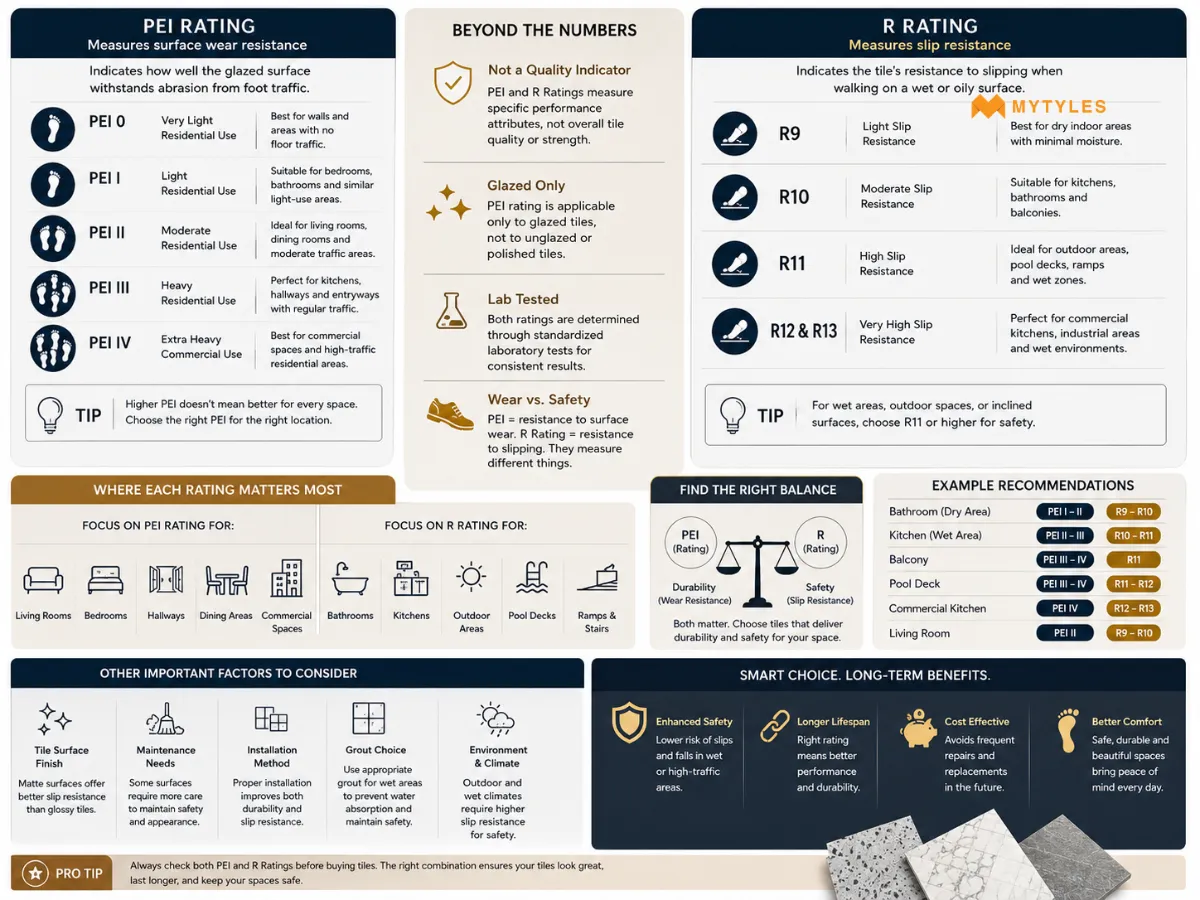
Ratings stop being theoretical the moment you place them in a real space. PEI and R ratings tell you where the tile belongs and where it absolutely doesn't. For example, a PEI 3 tile is suitable for regular home floors, like bedrooms, while a PEI 5 tile is better for heavy-use areas. This process happens the same way for R ratings also. This section explains what that looks like in each space.
Bathroom
Slip-resistant tiles come first in bathrooms, as they are exposed to water regularly. The R rating plays a big role here. For dry bathroom floors, R10 is usually enough, while shower areas, wet zones, or bathrooms used by elderly family members are better served by R11. You don't need to go above PEI 3 in residential bathrooms.
Kitchen
A PEI 3 or PEI 4 tile is usually a practical choice for the kitchen. Anything below PEI 3 and you'll start seeing surface wear within a few years. For slip-resistant tiles, R10 is a reasonable starting point, though areas closer to the sink or cooking zone, where spills are more frequent, may benefit from R11.
Bedroom & Living Room
These are dry, low-risk spaces, so the ratings here are more relaxed. PEI 3 is generally suitable for moderate traffic living rooms. For bedrooms, PEI 2 works fine. For grip, R9 is usually enough for dry indoor rooms, though R10 can be chosen if you want a slightly better surface.
Outdoor Areas
Outdoor areas are subject to weather, dust, water, and lots of foot traffic, so the tile quality ratings should reflect that. R11 works well for covered balconies, while open terraces are better served by R12. Given oil exposure, vehicle movement, and wet conditions, parking areas should go for R12 or R13. For wear, PEI 4 covers most outdoor home spaces, while parking needs PEI 5.
Commercial Spaces
Commercial floors handle far more than any home surface does. Shops, offices, showrooms, and restaurants need abrasion-resistant tiles in PEI 4 or PEI 5 because the foot traffic is constant. For grip, R10 works in dry commercial areas, while entrances, wash zones, and ramps should move to R11 or R12. Restaurant kitchens, industrial wet zones, and high-risk areas need R13, where grease, water, and heavy movement make lower ratings genuinely unsafe.
Getting The Rating Right Makes All The Difference
PEI and R ratings become much simpler when you know what each of them is measuring. The tile PEI rating is about durability, and the R-rating checks slip resistance. Neither one replaces the other, as both of them are equally important. The end result is the tile that does well in the place it was picked for. Not sure where to begin? Browse MyTyles’ tile collection and filter by space, finish, and size to find what works for yours. Talk to our tile experts for the best guidance about the tile quality ratings.
Expert Reviewed by Biren Agrawalla
Biren Agrawalla, the Founder of MyTyles with over 10 years of experience across tile, retail, and home decor. Driven by a passion for tiles and a deep understanding of customer behaviour, he has spent his career transforming how people discover and buy tiles online. Biren combines practical retail insight with modern digital solutions to make tile shopping smarter, more intuitive, and design focused. At MyTyles, he champions a customer first approach, ensuring every experience from browsing to buying is reliable, seamless, and inspiring.

What Is The Difference Between PEI And R Slip Ratings?

PEI and R ratings measure two different things. PEI is about durability and tells you how well a tile's surface holds up against foot traffic and wear over time. The R rating is about safety and measures how much grip a tile offers when the floor is wet or slippery. Both ratings are important but they answer different questions. PEI asks how long the tile will last. R asks whether it is safe to walk on in wet conditions.
What Is An R Rating In Tile?
The R rating comes from a German testing standard where tiles are placed on a ramp and tested with oil or slippery substances to see at what angle a person begins to lose footing. The result determines the grip level of the tile. Ratings run from R9 to R13. R9 offers basic grip for dry indoor areas while R13 is used in high risk wet zones like industrial kitchens, parking areas, and outdoor ramps where slip resistance is critical.
What Is A Good PEI Rating?
A good PEI rating depends entirely on where the tile is being used. For bedrooms and low traffic areas, PEI 2 or PEI 3 is usually enough. For kitchens, hallways, and busy home spaces, PEI 3 or PEI 4 is a more practical choice. Commercial spaces, shops, and parking areas need PEI 5 because the surface takes constant and heavy use. There is no single good rating and the right one is always the one that matches how the space actually gets used.
Do R Ratings Apply To Wall Tiles?
R ratings are primarily relevant for floor tiles and not wall tiles. Since walls do not carry foot traffic or deal with wet underfoot conditions, slip resistance is not a concern for wall surfaces. The R rating becomes important only when a tile is going on a floor, particularly in wet or high risk areas. For wall tiles, the focus shifts to PEI rating for durability and finish quality rather than grip.
Can The Same Tile Be Used For Both Floors And Walls?
Some tiles are rated for both floor and wall use but not all. A tile with a low PEI rating or no R rating listed is likely a wall tile and should not be placed on a floor, especially in wet or high-traffic areas. Always check the manufacturer's specification before using the same tile across both surfaces. A tile that looks identical to a floor tile may have a completely different build underneath that makes it unsuitable for floor use.
Does A Higher R Rating Mean The Tile Will Feel Rough Underfoot?
Not always, but there is usually a trade-off. Higher R ratings like R12 and R13 tend to have more textured or coarser surfaces to achieve a stronger grip, which can feel less smooth underfoot. However, many R11 tiles are available in finishes that are comfortable to walk on while still offering good slip resistance. The key is to look at both the R rating and the finish together rather than assuming a higher rating automatically means a rougher surface.
Is PEI Rating Relevant For Unglazed Or Vitrified Tiles?
The PEI rating is specifically designed for glazed ceramic and porcelain tiles and measures how well the glaze holds up against abrasion and wear. Unglazed tiles and fully vitrified tiles do not have a glaze layer so the PEI rating does not apply to them in the same way. For unglazed or vitrified tiles, durability is assessed differently based on the tile body itself rather than the surface glaze. Always check the product specification to understand how durability is measured for that specific tile type.

ABOUT THE AUTHOR
Nandana Priya
I have a strong interest in design and creativity, and I enjoy translating the world of tiles and their trends into engaging reads. Focusing on creating well-researched content that feels meaningful to readers has always been my first priority. I bring a growing understanding of research, design, and digital marketing into my writing, with a focus on clarity, relevance, and thoughtful storytelling.
Latest Blogs By MyTyles