Inspiration Gallery
Blog
Tile Calculator
08065423741



.svg)


The Coffee Corner Trend: How to Create One in a Small Indian Kitchen
ByHeena Dhiman

Thu , Nov 12 , 2026

Read Time: 5 Min


 Copied!

Your morning coffee might happen beside a chopping board, with the sugar jar behind the spice box and your favourite mug in a cupboard across the kitchen. By the time you find everything, the counter is already busy.
A separate coffee corner sounds lovely. But in a small Indian kitchen, where do you actually put it? There is often a mixer, a dish rack, and tomorrow's breakfast to think about.
The good news is that a coffee corner does not need a new cabinet or an entire wall. It could simply be a spot where the things you use for coffee stay together. These coffee corner ideas focus on what fits into a real kitchen, including one that still has to handle daily cooking.
Start With What You Actually Use
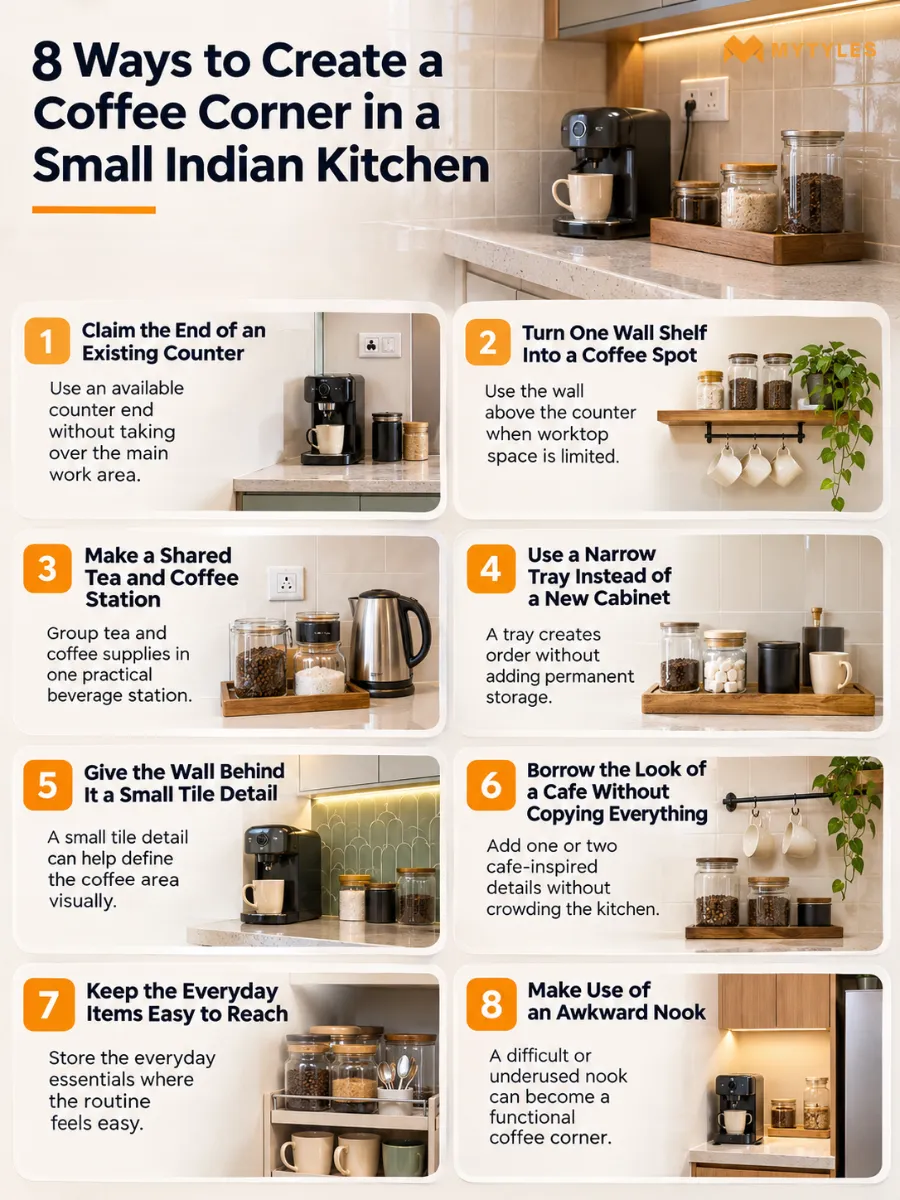
Before moving anything, think about how you make coffee. Instant coffee only needs a mug, coffee, sugar, and access to hot water or milk. A coffee machine needs a safe socket, room to fill its tank, and space to clean it. That difference matters more than the pictures you save online.
Look at your counter after breakfast, not when the kitchen is freshly cleaned. Which part usually stays free? That is a better starting point for your coffee corner design than buying a new rack first.
1. Claim the End of an Existing Counter
The end of the counter near a wall is often enough for a small kitchen coffee corner. Set a tray there with the coffee jar, sugar, and two mugs. Leave the centre of the counter free for cutting vegetables or rolling chapatis.
An L shaped kitchen may have a corner that is hard to use for chopping. It could hold a coffee setup instead, provided there is room to reach and clean everything. If the space sits beside the hob, look elsewhere. Oil splashes and steam will make the station harder to maintain.
The easiest test? Put your usual coffee items on the proposed spot for a week. If nobody needs to move them to cook dinner, the location is probably working.
2. Turn One Wall Shelf Into a Coffee Spot
When the counter is already full, use the wall above a suitable section of it. Keep mugs, coffee jars, and tea tins on a shallow shelf, leaving the counter below for making the drink.
Among coffee station ideas for home, this one makes sense when you want storage without another floor cabinet. Heavy items belong on a properly installed shelf with the right fixings for the wall. Do not place a shelf where it interferes with opening an appliance lid or traps heat and steam.
If you have several mismatched mugs, that is fine. Arrange the ones you use most at the front rather than trying to make every cup look identical.
3. Make a Shared Tea and Coffee Station
Not every Indian household drinks only coffee. One person may want filter coffee, another masala chai, and someone else may reach for hot chocolate.
Instead of giving each drink its own corner, create a kitchen beverage station. Use one container for tea supplies and another for coffee. Keep the kettle or hot water appliance in an open, suitable spot near a correctly rated socket, following its instructions.
This also means guests do not have to hunt through three cabinets for a teaspoon. A shared station is more useful than a coffee display that takes up space but gets used only once a week.
4. Use a Narrow Tray Instead of a New Cabinet
A compact coffee counter can be as simple as a washable tray placed on the existing worktop. The tray gives the jars a clear boundary, so they do not spread into the cooking area.
Pick one that you can lift for cleaning. Avoid crowding it with artificial plants, signs, and extra cups. You still need room to place a hot mug down.
For a rented flat, this is one of the easiest coffee nook ideas to try. Nothing needs to be drilled or permanently fitted. If the setup gets in the way, move the tray to another part of the kitchen.
5. Give the Wall Behind It a Small Tile Detail
Maybe the coffee corner sits on a plain stretch of wall, and you want it to look a little different from the rest of the kitchen. A short backsplash section could do the job.
Consider coffee bar backsplash tiles only on the part of the wall that serves the station, rather than covering every nearby surface with a bold pattern. Small square tiles, a simple subway layout, or a restrained geometric print can give the area a clear boundary.
A tiled coffee station is also easier to picture when the wall colour, counter, and tiles are considered together. For example, cream tiles beside a dark worktop create a different look from pale green tiles against light wood cabinets.
Tiles and grout still need regular cleaning, and suitability depends on the product and installation. They are not a substitute for waterproofing where that is required.
6. Borrow the Look of a Cafe Without Copying Everything
A cafe-style kitchen does not need exposed brick, a chalkboard, or rows of matching cups. In a small space, a single detail is often enough.
Try a warm coloured cup rack, a small framed print away from splashes, or two jars in similar shapes. If your cabinets are already dark, a light backdrop may keep the corner from looking crowded. With white or beige cabinets, a deeper tile colour on a limited area can help mark out the coffee spot.
A kitchen accent wall is an option, but a whole wall may be more than you need. Look at the corner from the doorway before deciding how much colour or pattern to add.
7. Keep the Everyday Items Easy to Reach
Think of the order in which you make coffee. You pick up a cup, add coffee, reach for sugar, and then add water or milk. Place the objects in roughly that order.
Good kitchen shelf styling starts with convenience. Keep the coffee you use every morning within reach. Extra beans, refill packets, rarely used cups, and serving bowls can go in a drawer or closed cabinet.
Open jars can gather grease and dust in a busy kitchen, especially near the stove. Containers with lids are easier to manage. Store coffee according to its packaging instructions and keep electrical equipment clear of spills.
8. Make Use of an Awkward Nook
Some kitchens have a small recess beside the fridge or a short counter near the entrance. This could become a small apartment coffee nook, but only if it does not obstruct the fridge door, a passage, or another appliance.
Measure the machine or tray before committing. Remember to check the extra clearance needed to open a lid, remove a water tank, or reach the plug. A space that fits the appliance on paper may still be annoying in daily use.
No available worktop at all? A nearby dining sideboard may be a better home for mugs and dry supplies. Keep powered equipment where its electrical and ventilation requirements can be met.
What to Check Before Setting It Up
A pretty corner becomes frustrating when it is difficult to clean or blocks the kitchen during meal preparation. Check these things before buying shelves or tiles:
• Space: Can someone still prepare food and use nearby cabinets?
• Water and cleaning: Is it easy to fill the appliance and wipe up spills?
• Electricity: Is there a suitable wall socket, away from water and heat? Follow appliance guidance and avoid overloaded adapters.
• Steam and heat: Does the appliance have the clearance stated by its maker?
• Storage: Can you reach the everyday items without moving decorations?
• Surfaces: Are the tiles, grout, shelf material, and worktop suitable for their intended use?
You can start with a tray and change the arrangement later. That is often more sensible than committing to built in storage before you know how the area works.
Your Own Coffee Corner Starts With a Little Space
A coffee corner earns its place in a small kitchen when it makes your morning easier without taking over the room. Begin with the things you use, find a spot that stays clear of daily cooking, and add the decorative details after the layout works.
If a small tile backdrop is part of your plan, MyTyles has kitchen wall tile designs in different colours, patterns, and finishes to compare. You can visit the MyTyles website or Experience Centre to see how a possible backsplash might look alongside your cabinets and counter.

Can I Make a Coffee Corner Without a Coffee Machine?

Yes. Keep instant coffee, cups, teaspoons, and sugar together on a tray or shelf. If you use a kettle, follow its safety and clearance instructions. The point is to make the routine convenient, not to buy more equipment.
Where Should I Put a Coffee Station in a Small Kitchen?
Try a counter end or an underused corner away from the hob and washing area. Check whether cabinet doors are still open and the spot stays free during meal preparation. A dining sideboard can also hold dry supplies.
How Much Counter Space Does a Coffee Corner Need?
There is no single required size. Measure your own tray or appliance, then allow space to set down a mug, fill a water tank, and clean the area. A simple instant coffee setup needs less room than an espresso machine.
What Tiles Work Behind a Coffee Corner?
Ceramic or other wall tiles may be considered if the individual product suits the location. Choose a pattern that fits the small area, and check cleaning needs, installation guidance, and grout care before deciding.
Can I Create a Coffee Nook in a Rented Flat?
Yes. A removable tray, existing shelf, or section of a sideboard may be enough. Avoid permanent drilling or wall changes without permission. Keep the setup clear of doorways, sinks, and hot cooking areas.
How Do I Keep a Coffee Corner Clean in an Indian Kitchen?
Place it away from the hob where possible. Use closed jars, wipe the counter regularly, and keep spare supplies in a cupboard. A washable tray can be lifted so you can clean underneath it.
Should I Use Open Shelves or Closed Cabinets for Coffee Supplies?
Open shelves make frequently used mugs easy to reach. Closed cabinets are useful for refill packs and items you do not use daily, especially where cooking grease and dust are concerns. A mix of both can be practical.

ABOUT THE AUTHOR
Heena Dhiman
With a background in fashion design and over 5 years of writing experience, I bring a creative and detail-oriented eye to home and design content. My journey began with aesthetics, colours, and visual storytelling, which gradually led me to writing across lifestyle, finance, home improvement, and resource management. Over time, I discovered a strong interest in tiles and interiors, where my design background helps me understand how small choices can shape the feeling of a home. Through my content, I aim to make home design decisions easier, clearer, and more enjoyable for readers, helping them feel confident while creating spaces that reflect their style and everyday needs.