Inspiration Gallery
Blog
Tile Calculator
08065423741



.svg)


What Is a Rectified Tile, and Why Does the Edge Matter?
ByNabiya Naqvi

Mon , Oct 26 , 2026

Read Time: 5 Min


 Copied!
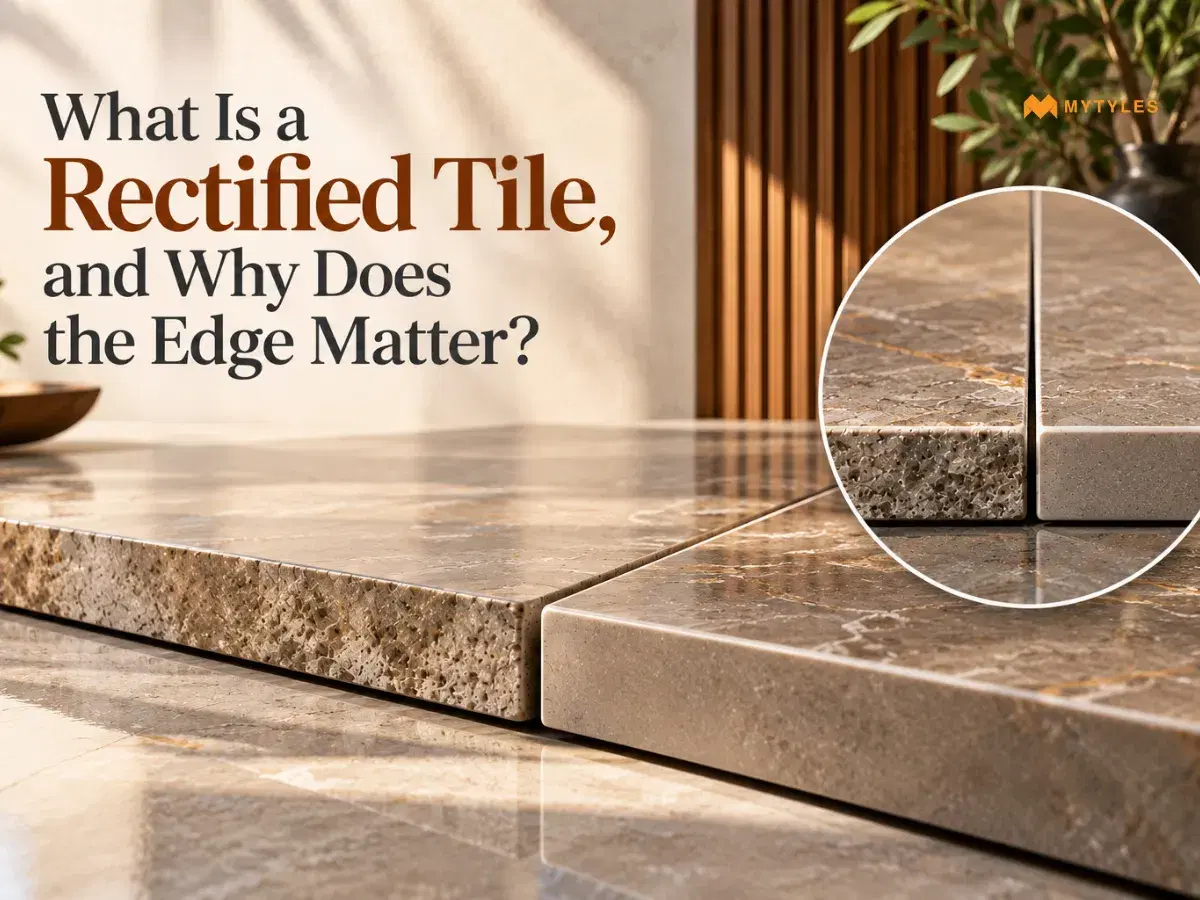
Just when you think you've made your final choice of tile material, finish, and colour, you have one more choice to consider: rectified or non-rectified tiles. Modern tiles are manufactured with advanced techniques. During firing, slight dimensional variations may still occur that aren't noticeable to the eye.
Rectification is an edge-finishing process in which the edges of the tiles are mechanically cut or ground to give the tiles more precise dimensions and uniform edges. This doesn’t mean that rectified tiles are better than non-rectified tiles, but it can have an impact on how the tiles are planned and laid. In this blog, we explain what rectified tiles are, how the edges are treated, the installation of rectified tiles, rectified tile lippage and how they differ from non-rectified tiles.
Define Rectified Tile
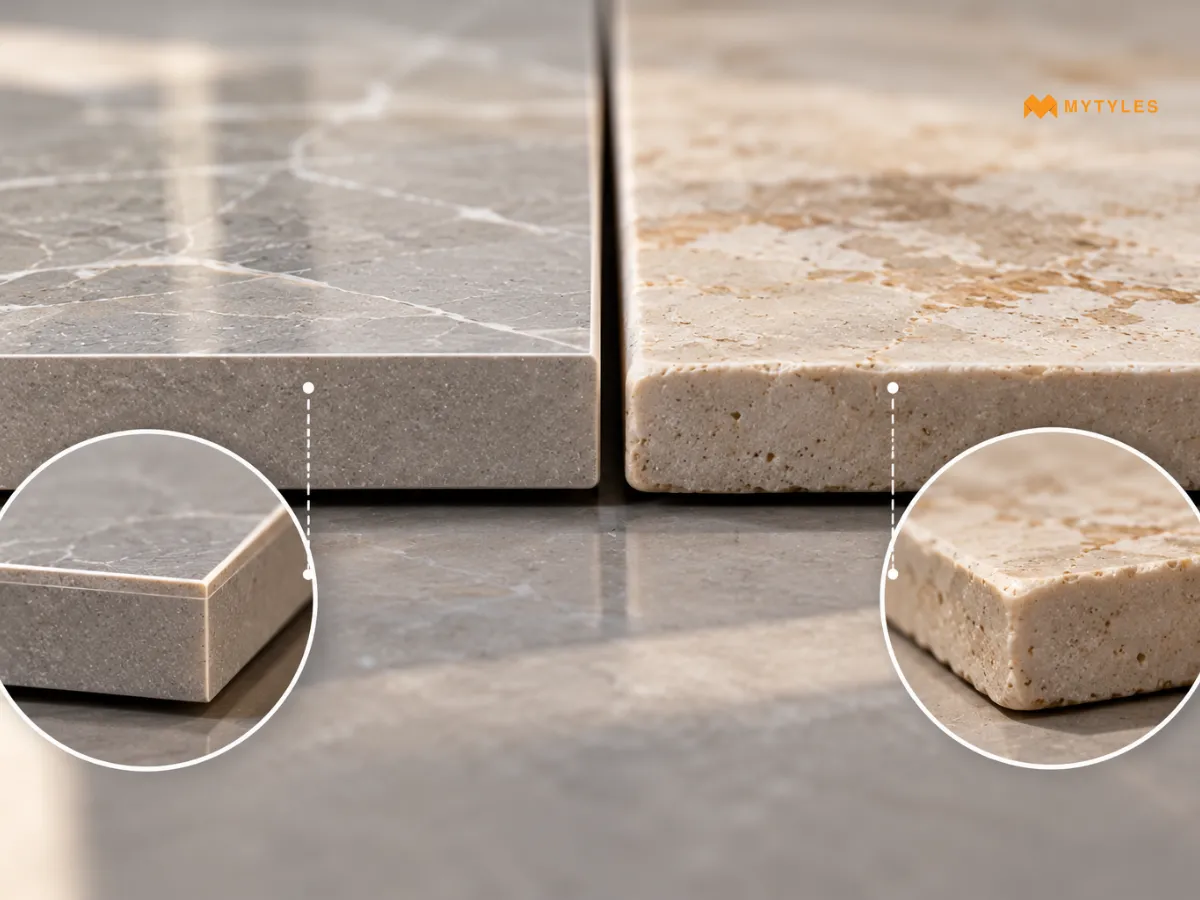
The term ‘rectified tile’ refers to a specific post-production process. Once a tile is fired in the kiln, it undergoes a mechanical cutting process.
This results in straighter edges and more precise facial dimensions. A non-rectified tile, also called a pressed-edge tile, does not go through this cutting process. The edges of a pressed tile are formed during the pressing stage, before firing. Because the kiln firing process causes slight dimensional shifts, pressed-edge tiles carry a degree of natural size variation across a batch. That variation is expected and accounted for by using wider grout joints.
Rectified Tiles vs Non-Rectified Tiles
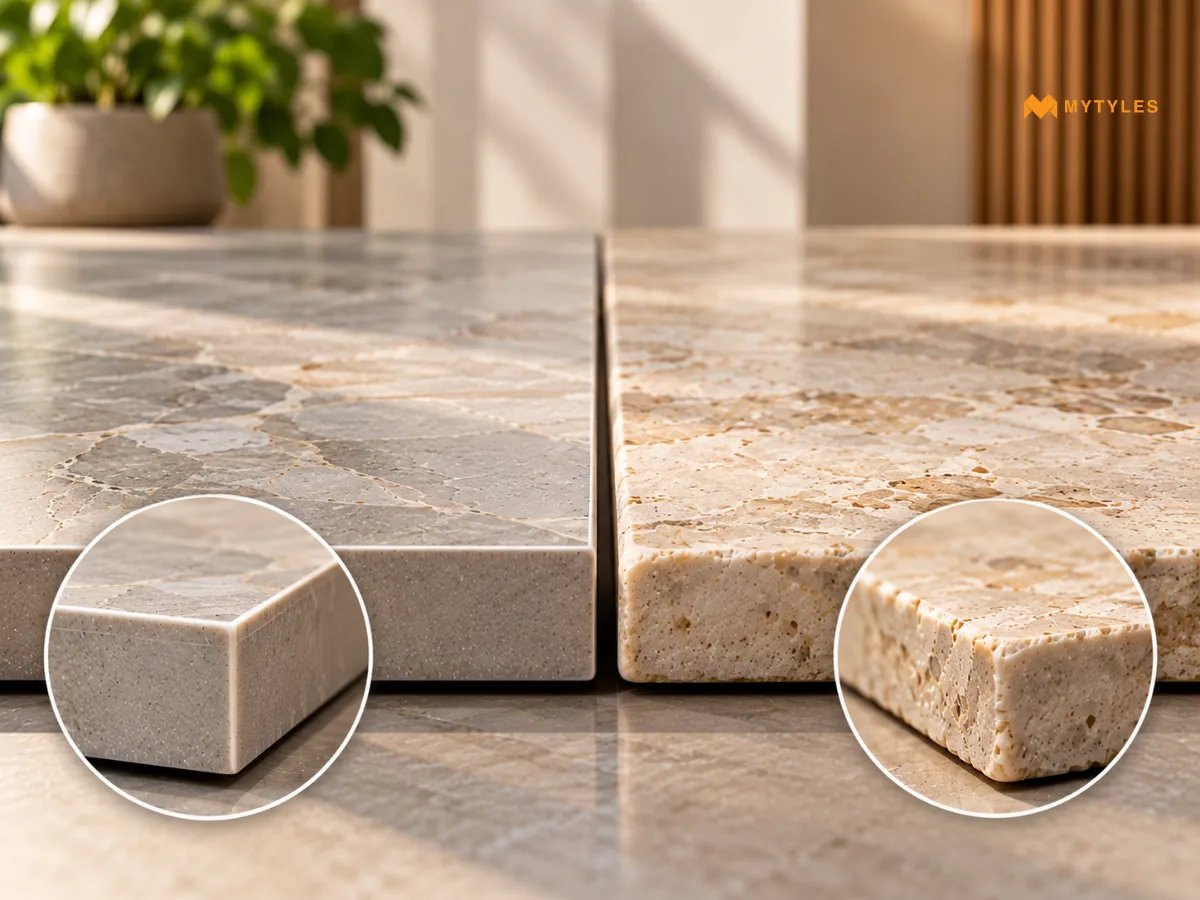
Rectified tiles have a few important characteristics, such as a finished look and sharp edges, but that doesn’t mean they are better than non-rectified tiles. The table below shows how the tiles are different from each other and what their individual characteristics are.
Factors | Rectified Tiles | Non-Rectified Tiles |
Edge | Mechanically finished for straighter, more uniform edges | Edges retain their original post-firing characteristics |
Dimensional Consistency | More precise facial dimensions | May have greater dimensional variation between tiles |
Grout Joints | Can allow narrower grout joints where permitted by the tile and installation requirements | May require wider joints to accommodate dimensional variation |
Finished Appearance | Narrower joints can create a more continuous-looking tiled surface. | Wider joints can make the individual tile layout more visually defined. |
Installation Planning | Requires careful substrate preparation, alignment and joint planning | Joint width should account for tile variation and installation requirements |
Why the Edge Matters for Grout Lines
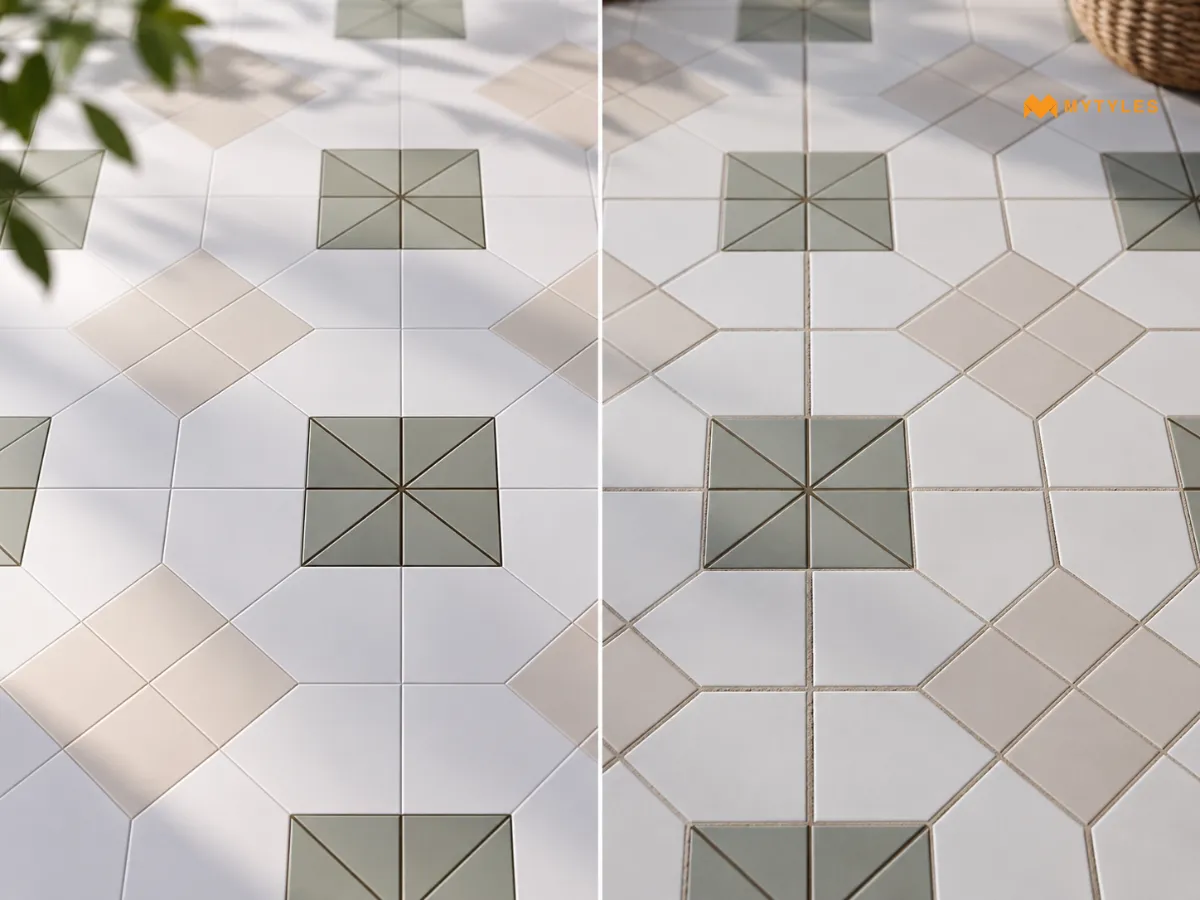
Rectified tile grout lines are one of the most visible differences between rectified and non-rectified installations. Narrow grout joints on a large-format floor tile can give the surface a cleaner, more continuous look. The eye travels across fewer interruptions. The individual tile is more prominent, and the grid pattern less so.
Wider grout joints on pressed-tile edges make the grid more visible. This is not necessarily a problem. In some design directions, wider joints with a contrasting grout colour are a deliberate choice. In others, the preference is for the tile to read as a surface rather than a grid.
The decision about narrow grout joints versus wider ones should be made before the tile is selected rather than after, because it directly influences which type of tile is appropriate for the project.
What Is Tile Lippage, and How Does Edge Type Affect It?
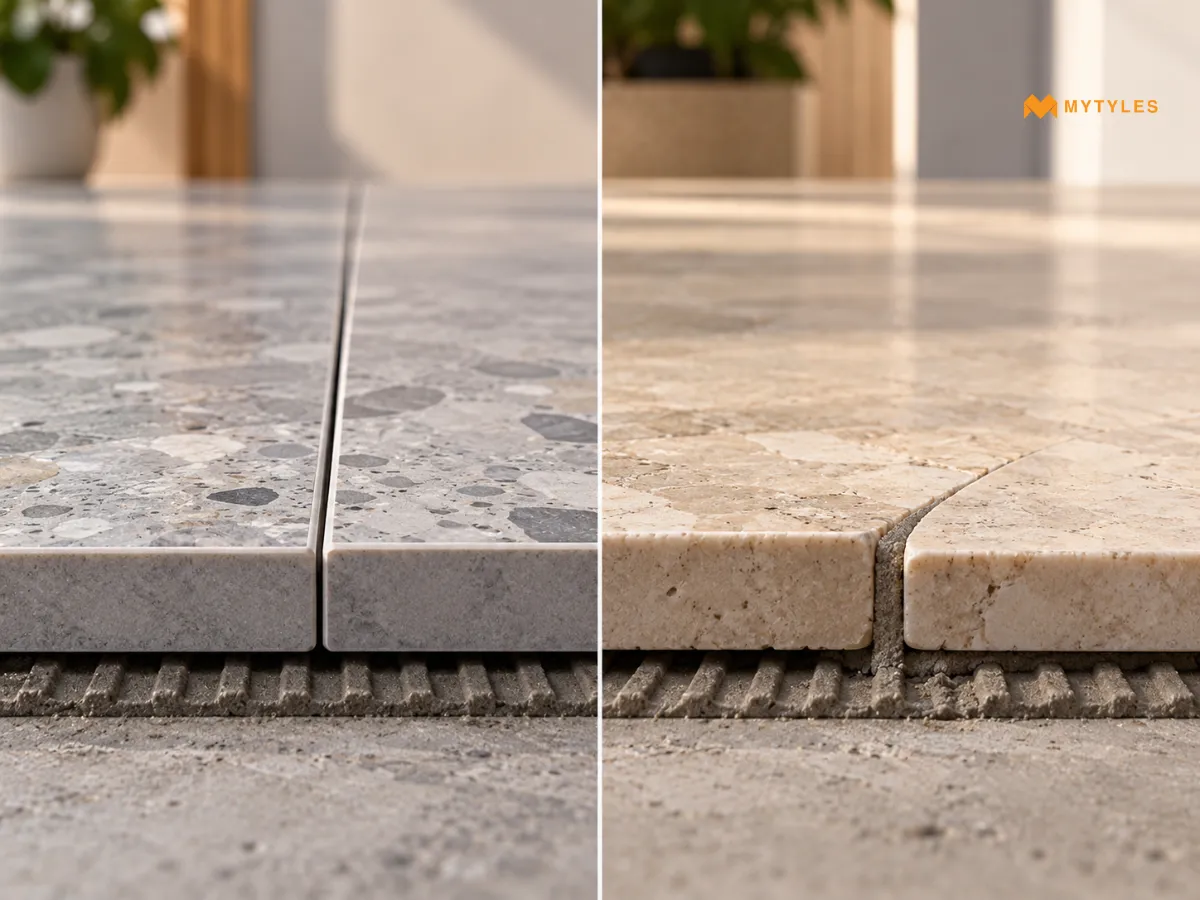
'Lippage' refers to the height difference between two adjacent installed tiles where one edge sits higher than the other. It can occur with both rectified and non-rectified tiles. Rectification itself does not determine whether lippage will occur, as several factors influence the finished surface.
Rectified tiles have consistent dimensions, which means the installer is working with predictable edges throughout. Lippage control depends on the substrate flatness, the adhesive application, and the levelling system used during installation rather than variation in the tile itself.
Non-rectified tiles carry inherent size variation that the installer manages through joint width and laying technique. The wider joint absorbs dimensional differences that could otherwise cause lippage at the tile edges.
For large-format rectified floor tiles, lippage control is more demanding than for smaller tiles because the longer tile edge means any height difference is more visible across the surface. A flat, stable substrate and proper levelling during installation are required for large-format rectified tiles to read correctly once grouted.
Rectified Tile Installation: What to Know Before You Start
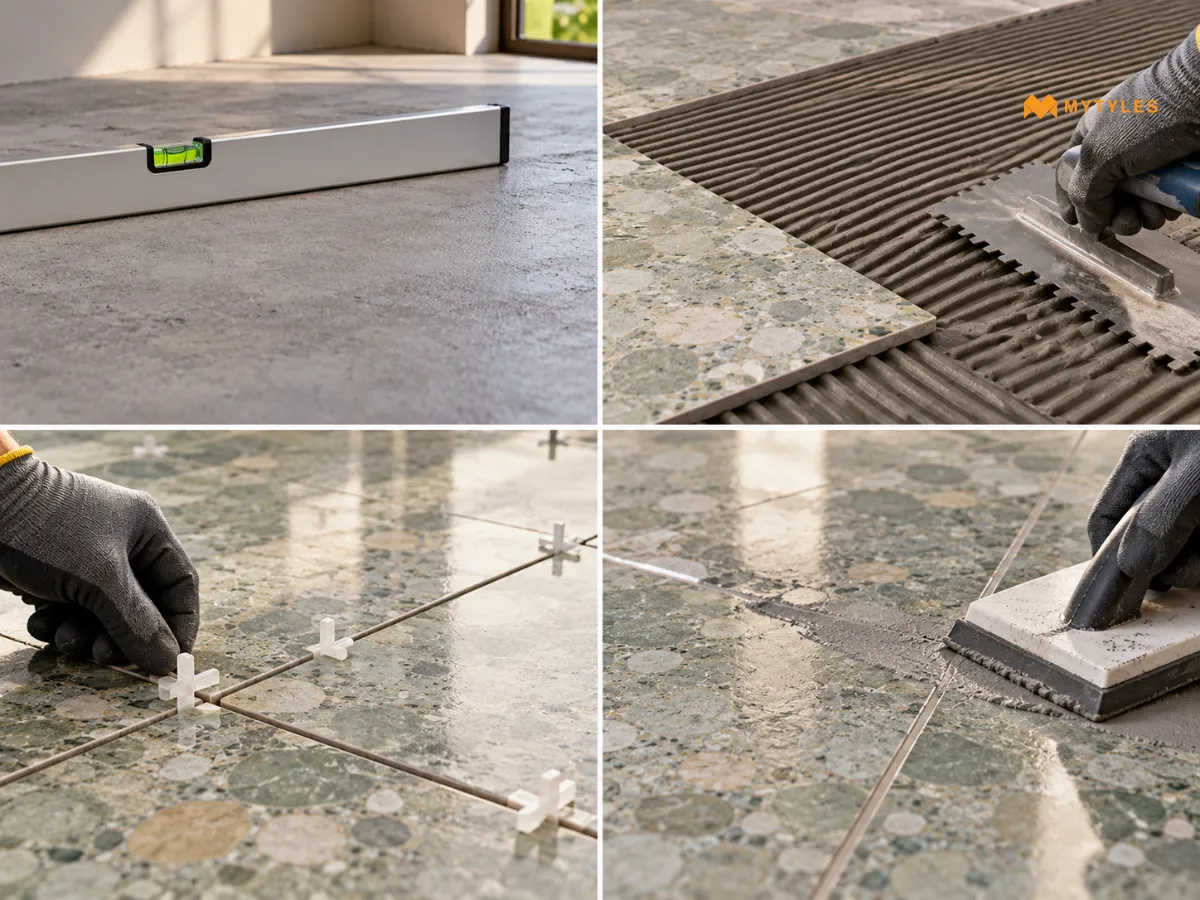
Laying rectified tiles correctly depends on getting several things right before the first tile goes down.
- Substrate flatness: Rectified tiles require a flatter substrate than pressed-edge tiles. Any irregularity in the substrate can affect the tile surface and alignment. The substrate needs to be checked and prepared to a flat level.
- Adhesive coverage: Appropriate adhesive coverage is important for both rectified porcelain and rectified ceramic tiles. This prevents voids, which can cause tile movement over time and may lead to cracking. Spot bonding is not suitable for rectified tiles, especially for larger sizes.
- Joint width: The intended joint width should be confirmed before laying starts. Changing the joint width mid-installation affects how the surface reads across the full floor or wall area. Use consistent spacers throughout.
- Grouting rectified tiles: Grouting rectified tiles with narrow joints requires a grout that is formulated for tight joints. Grout may not flow and compact correctly into a very narrow joint. Check the grout manufacturer's recommendation for the specific joint width before selecting the product.
Choosing Between Rectified and Non-Rectified Tiles
The difference between rectified and non-rectified tiles comes down primarily to how their edges and dimensions are finished, but the choice can influence joint planning and the final layout. Neither is necessarily the best choice for all projects. Tiles with rectified edges can create narrower, more uniform joints when the tile and installation allow, while non-rectified tiles have varying edge and dimensional characteristics that you should account for when planning a layout.
Choose rectified tiles based on your desired layout, tile size, edge characteristics, and application and installation requirements. Find the ideal rectified edge tile for your project at MyTyles. Browse the collection of ceramic, vitrified and porcelain tiles. Check the individual product specifications to confirm whether a particular tile is rectified before ordering.

What Is a Rectified Tile?

A rectified tile has its edges mechanically finished after firing to achieve more precise facial dimensions and straighter edges. Rectification describes the edge-finishing process, not the tile’s material, finish or performance level. When comparing products, check whether the individual tile is identified as rectified rather than assuming it from its appearance.
What Is the Difference Between Rectified and Non-Rectified Tiles?
The main difference concerns the edge geometry and dimensional consistency. Rectified tiles undergo additional mechanical edge finishing after firing, while non-rectified tiles do not undergo this rectification step. This distinction can influence joint planning and the finished layout, but it does not by itself determine strength, water absorption, durability or application suitability.
Do Rectified Tiles Need Grout?
Yes. Rectified edges do not mean tiles should automatically be installed without grout joints. The appropriate joint width depends on factors including the particular tile, dimensional variation, layout and installation requirements. Follow the tile and installation-system recommendations rather than assuming that rectified tiles can be placed directly against one another without joints.
Can Rectified Tiles Have Smaller Grout Joints?
Rectified tiles can allow narrower and more consistent-looking joints because their edges are mechanically finished to more precise dimensions. However, there is no single joint width appropriate for every rectified tile installation. Tile size variation, layout, substrate conditions and manufacturer or installation-system requirements should be considered before deciding the planned grout-joint width.
Are Rectified Tiles Better Than Non-Rectified Tiles?
Not automatically. Rectification concerns the precision of the tile edges rather than establishing overall product quality. Rectified tiles can suit layouts where precise dimensions and narrower-looking joints are desired, while non-rectified tiles have different edge characteristics. Material, stated application, dimensions, surface characteristics and relevant technical specifications should be assessed separately when comparing products.
Are Rectified Tiles More Difficult to Install?
Rectified tile layout requires joint planning and alignment because differences between neighbouring tile edges can be noticeable in closely spaced installations. Installation requirements also depend on tile dimensions, substrate condition, tile variation and chosen pattern. Rectification itself does not remove the need for appropriate substrate preparation or other product-specific installation requirements.
Do Rectified Tiles Prevent Lippage?
No. Rectification makes the tile edges more dimensionally precise, but it does not by itself prevent lippage, which is a height difference between adjacent tile edges. Tile curvature, substrate condition, installation, layout and other factors can influence the finished surface. Rectified edges should therefore not be treated as a guarantee of perfectly level neighbouring tiles.

ABOUT THE AUTHOR
Nabiya Naqvi
Nabiya Naqvi is a content writer with a postgraduate background in chemical sciences and a strong passion for creative expression. Her journey into writing began with a love for storytelling and gradually grew into a professional path focused on interiors, home decor, and design-led content. With a keen interest in beautiful living spaces, Nabiya enjoys simplifying design ideas and making them relatable for everyday readers. Through her writing, she blends creativity, research, and an eye for detail to help homeowners understand how tiles, textures, and thoughtful material choices can transform a space.
Latest Blogs By MyTyles